Programmatic SEO Architecture using Next.js and Headless CMS: in 2025
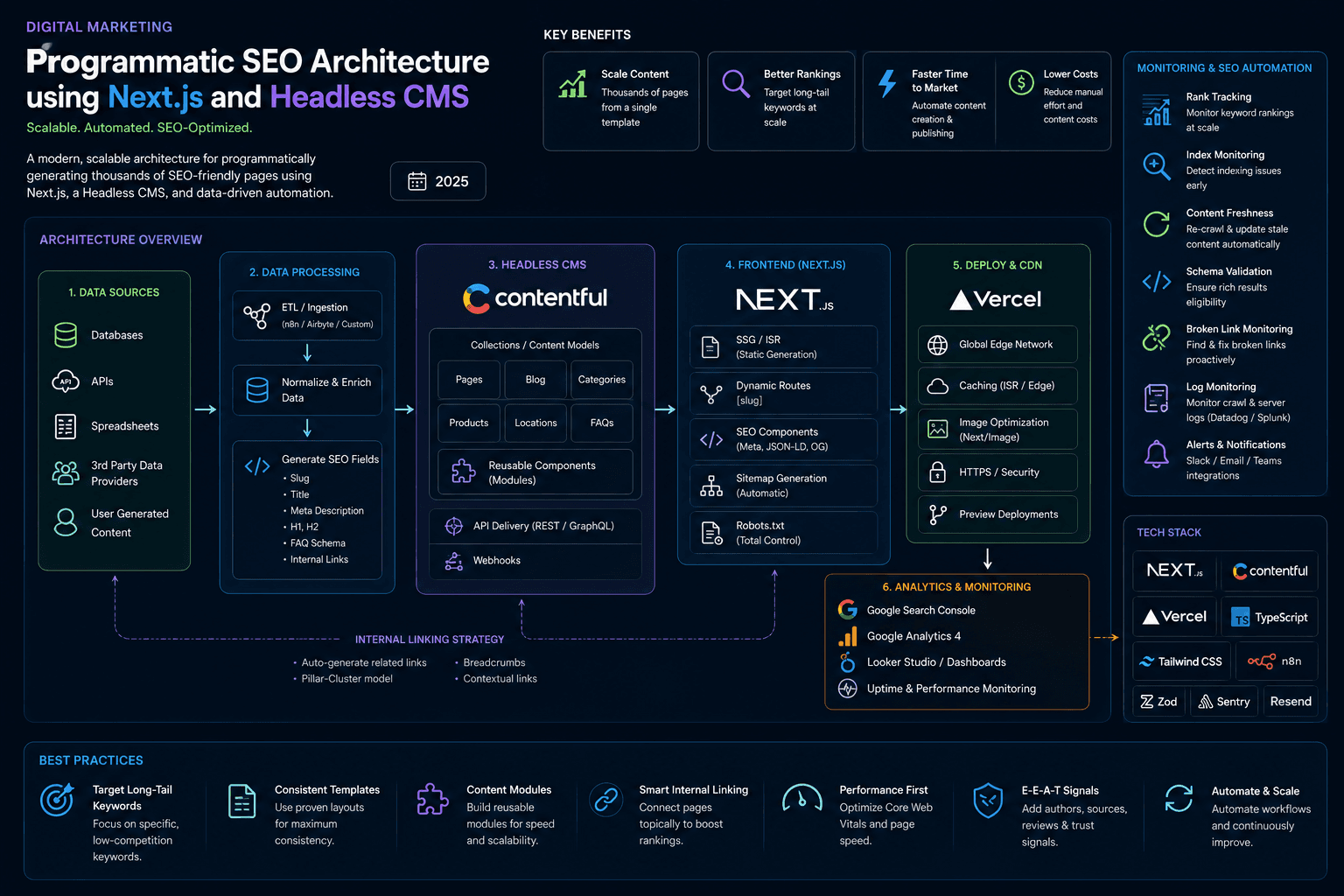
An in-depth enterprise guide exploring programmatic seo architecture using next.js and headless cms. We examine core architectural decisions, data integration pipelines, scaling bottlenecks, and production-grade implementation strategies.
Dr. Elena Vance
VP of AI Research
Introduction: The Strategic Context of Programmatic SEO Architecture using Next.js and Headless CMS
Digital marketing has transformed from a creative discipline into a highly analytical, technical science. In an era where user privacy is regulated and browser tracking is restricted, the brands that win are those that collect first-party data and measure attribution with absolute accuracy. Scalable growth relies on building technical infrastructure that aligns marketing funnels with product analytics. At the core of modern growth marketing is the need to optimize customer acquisition costs (CAC) while scaling reach. This requires marketing and engineering teams to work together to implement server-side tracking, optimize search engine visibility, automate landing page generation, and build data pipelines that deliver real-time attribution insights to decision-makers.
Core Architectural Principles
A major shift in digital analytics is the move from client-side tracking to server-side tracking. Client-side tracking, which relies on JavaScript tags running in the user's browser, is increasingly blocked by ad blockers, VPNs, and privacy settings (like Safari's ITP). Server-side tracking routes event data through a secure cloud container first, bypassing browser restrictions and delivering 100% attribution accuracy. Another critical pillar is Programmatic SEO. Programmatic SEO is the practice of programmatically generating thousands of high-quality, search-optimized landing pages to target long-tail, high-intent keywords. Building a scalable web architecture that supports this (such as Next.js dynamic routing coupled with a headless CMS) allows organizations to capture search traffic at a fraction of the cost of manual content creation.
Deep Dive Implementation Details
At the content layer, search engine optimization (SEO) requires a cluster-based content strategy. Rather than targeting isolated keywords, marketers organize content into thematic 'hubs' (pillar pages) and 'spokes' (supporting articles) connected by internal links. This structure signals topical authority to search engines, helping the domain rank for highly competitive terms. Conversion Rate Optimization (CRO) is the engineering counterpart of marketing. A user landing on a page represents a marketing cost; converting that user into a lead or customer is where profitability is decided. Marketers must optimize conversion paths by simplifying lead-capture forms, using clear calls-to-action (CTAs), and ensuring landing pages load in under a second.
Critical Scaling Bottlenecks
The primary bottleneck in data-driven marketing is data fragmentation. When marketing spend is recorded in one platform, web traffic in another, and CRM sales in a third, calculating true return on ad spend (ROAS) is impossible. Organizations must build data integration pipelines that ingest data from all sources into a central data warehouse (like Snowflake or BigQuery) for analysis. Another scaling challenge is managing marketing automation workflows at scale. When sending personalized email sequences to hundreds of thousands of users, the system must avoid duplicate sends, manage email deliverability, and respect user unsubscribe preferences. Designing robust database queues and integrating with reliable transactional email APIs ensures reliable message delivery.
Security, Trust & Compliance
Marketing practices must align with global privacy regulations, including GDPR, CCPA, and India's DPDPA. This means obtaining explicit consent from users before tracking their behavior or sending them marketing communications. Implementing cookie consent banners and maintaining secure opt-out databases is a legal requirement for global organizations. Data security is also critical when handling customer contact information. Marketing lists and CRM databases contain sensitive personal data (such as emails and phone numbers) that must be protected. Enforcing strict access controls, encrypting data at rest and in transit, and auditing access logs prevents data breaches and protects user privacy.
Performance Benchmarking & Telemetry
To measure the effectiveness of marketing campaigns, growth teams must implement multi-touch attribution (MTA) models. Unlike simple last-click attribution, which attributes all value to the final touchpoint, MTA models distribute value across every interaction a user had with the brand. This provides a realistic view of how content, ads, and emails work together to drive conversions. Continuous A/B testing is the engine of optimization. Growth teams should set up structured experiments to test variations of headlines, copy, colors, and layout structures. Tracking performance using statistical significance testing ensures that changes are adopted based on real user behavior rather than subjective preferences, steadily improving overall conversion rates.
Summary & Operational Takeaways
To conclude, scaling digital marketing in a modern enterprise requires a technical foundation. By implementing server-side tracking, leveraging programmatic SEO, integrating data silos, respecting user privacy regulations, and validating changes through structured A/B testing, organizations can build sustainable, highly optimized growth engines that drive predictable revenue.
Written by
Dr. Elena Vance
VP of AI Research
Dr. Elena Vance writes about engineering, design, and AI at Magnence — sharing lessons learned from shipping production systems for clients across 13+ industries.