Multi-Region Kubernetes Deployments for High Availability: Case Study
An in-depth enterprise guide exploring multi-region kubernetes deployments for high availability. We examine core architectural decisions, data integration pipelines, scaling bottlenecks, and production-grade implementation strategies.
Dr. Elena Vance
VP of AI Research
Introduction: The Strategic Context of Multi-Region Kubernetes Deployments for High Availability
Cloud infrastructure is the foundation upon which modern digital services are built. As applications grow to support millions of users worldwide, the underlying systems must adapt to be highly available, secure, and cost-effective. Designing a scalable cloud architecture means building for redundancy, automating resource provisioning, and preparing for system failures at every layer. In the early stages of a startup, infrastructure is often set up manually, resulting in configuration drift and environment discrepancies. As the company scales, manual management becomes a liability, leading to outages and security vulnerabilities. Enterprise cloud engineering requires a shift toward automation, standardizing infrastructure as code, and enforcing security policies dynamically.
Core Architectural Principles
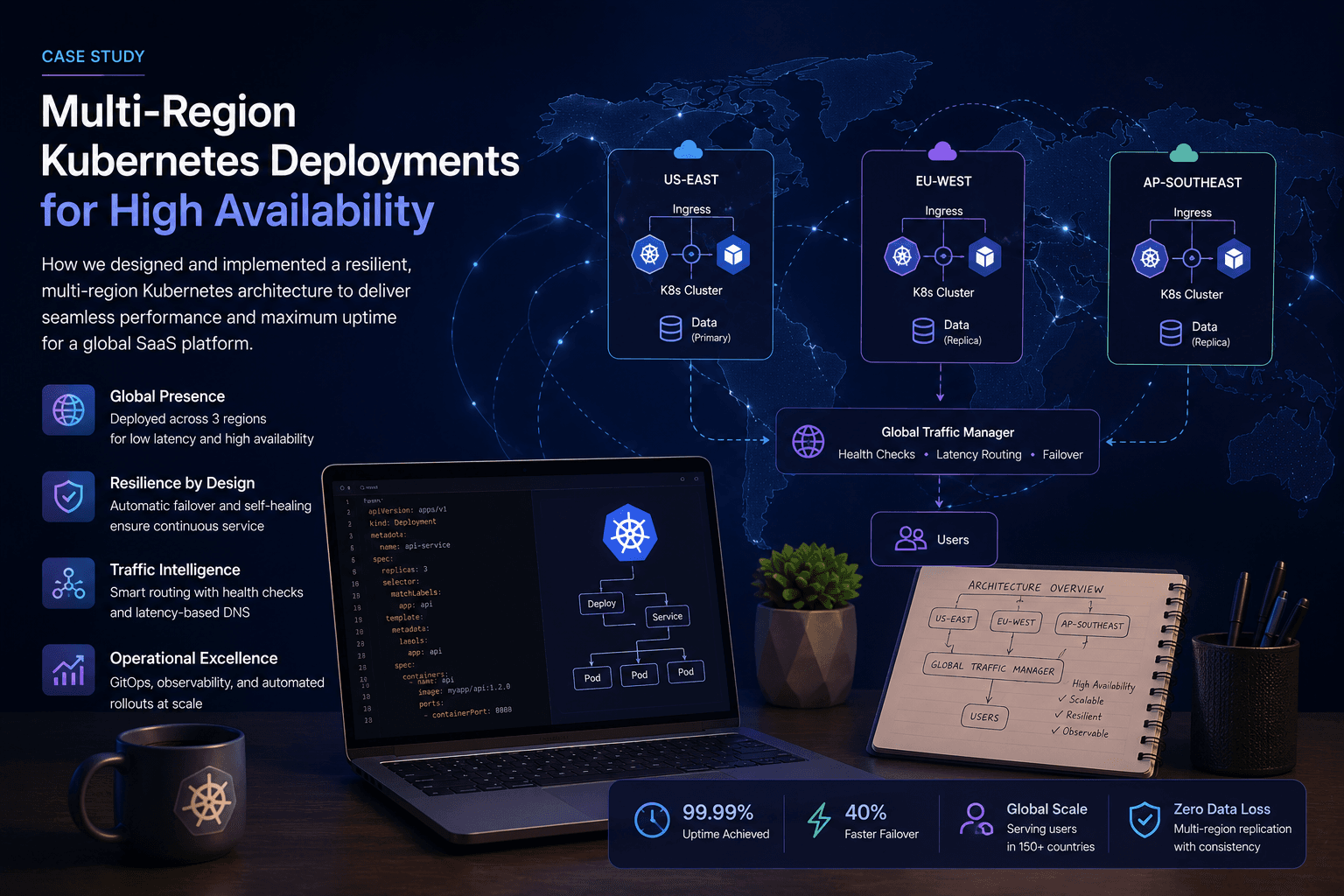
Multi-region deployment is a core strategy for achieving high availability and disaster recovery. By running application instances in multiple physical data centers (such as AWS us-east-1 and ap-south-1), organizations can route traffic away from regional outages. This distribution also reduces latency by serving global users from the nearest physical location. To manage containerized applications across these regions, Kubernetes has become the standard orchestration platform. Kubernetes automates container deployment, scaling, and management. Using managed services like AWS EKS or GCP GKE simplifies cluster operations, allowing engineering teams to focus on application deployment rather than bare-metal server maintenance.
Deep Dive Implementation Details
Infrastructure as Code (IaC) is the practice of managing and provisioning infrastructure through machine-readable definition files. Tools like Terraform allow developers to define servers, networks, databases, and IAM policies in code. Versioning these definition files in Git ensures that staging and production environments remain identical, making deployments repeatable and predictable. Database scaling is another critical cloud engineering focus. For read-heavy applications, deploying database read replicas offloads traffic from the primary write node. Implementing database connection poolers (like PgBouncer for PostgreSQL) prevents the database from running out of file descriptors under heavy concurrent load, ensuring stable database response times during traffic spikes.
Critical Scaling Bottlenecks
A common bottleneck in cloud environments is cloud waste and uncontrolled billing. When developers spin up test environments and leave them running, or over-provision VM sizes, cloud bills can spike. Implementing FinOps practices—such as resource tagging, auto-shutdown schedules for non-production environments, and using spot instances—can reduce overall cloud spend by up to 40%. Another scaling challenge is managing network latency and bandwidth. Moving data between cloud services or across regions can be slow and expensive. Designing efficient network topologies, using private VPC peering instead of routing traffic over the public internet, and utilizing Content Delivery Networks (CDNs) to cache data at edge locations reduces latency and slashes bandwidth costs.
Security, Trust & Compliance
Cloud security relies on a zero-trust model and the principle of least privilege. This means that every user, service, and application is granted only the minimum permissions required to perform its function. Enforcing strict Identity and Access Management (IAM) policies, using temporary security credentials, and auditing access logs prevents unauthorized access. Network security is also paramount. Segmenting the network into public subnets (for load balancers) and private subnets (for databases and application servers) prevents direct exposure to the public internet. Implementing Web Application Firewalls (WAF) and automated DDoS protection protects cloud endpoints from malicious traffic and security threats.
Performance Benchmarking & Telemetry
To verify infrastructure stability, cloud teams must conduct regular load testing and chaos engineering. Load testing involves simulating peak traffic volumes to identify bottlenecks in auto-scaling rules or database connections. Chaos engineering (using tools like Chaos Mesh) involves intentionally introducing failures—such as shutting down a database node or injecting network latency—to confirm the system recovers automatically. Comprehensive monitoring and alerting is the final pillar of cloud operations. Teams should collect metrics on CPU usage, memory utilization, disk I/O, and network throughput. Setting up automated alerts (using tools like Prometheus and Alertmanager) ensures that operations teams are notified immediately if a resource exceeds healthy thresholds, allowing them to intervene before an outage occurs.
Summary & Operational Takeaways
To summarize, building resilient cloud infrastructure requires automation, redundancy, cost discipline, and zero-trust security. By leveraging Infrastructure as Code, multi-region container orchestration, PgBouncer pooling, FinOps cost optimization, and proactive chaos testing, cloud engineers can build scalable platforms that support global applications with absolute reliability.
Written by
Dr. Elena Vance
VP of AI Research
Dr. Elena Vance writes about engineering, design, and AI at Magnence — sharing lessons learned from shipping production systems for clients across 13+ industries.