High-Throughput Data Pipelines with Kafka and Rust: Best Practices
An in-depth enterprise guide exploring high-throughput data pipelines with kafka and rust. We examine core architectural decisions, data integration pipelines, scaling bottlenecks, and production-grade implementation strategies.
Dr. Elena Vance
VP of AI Research
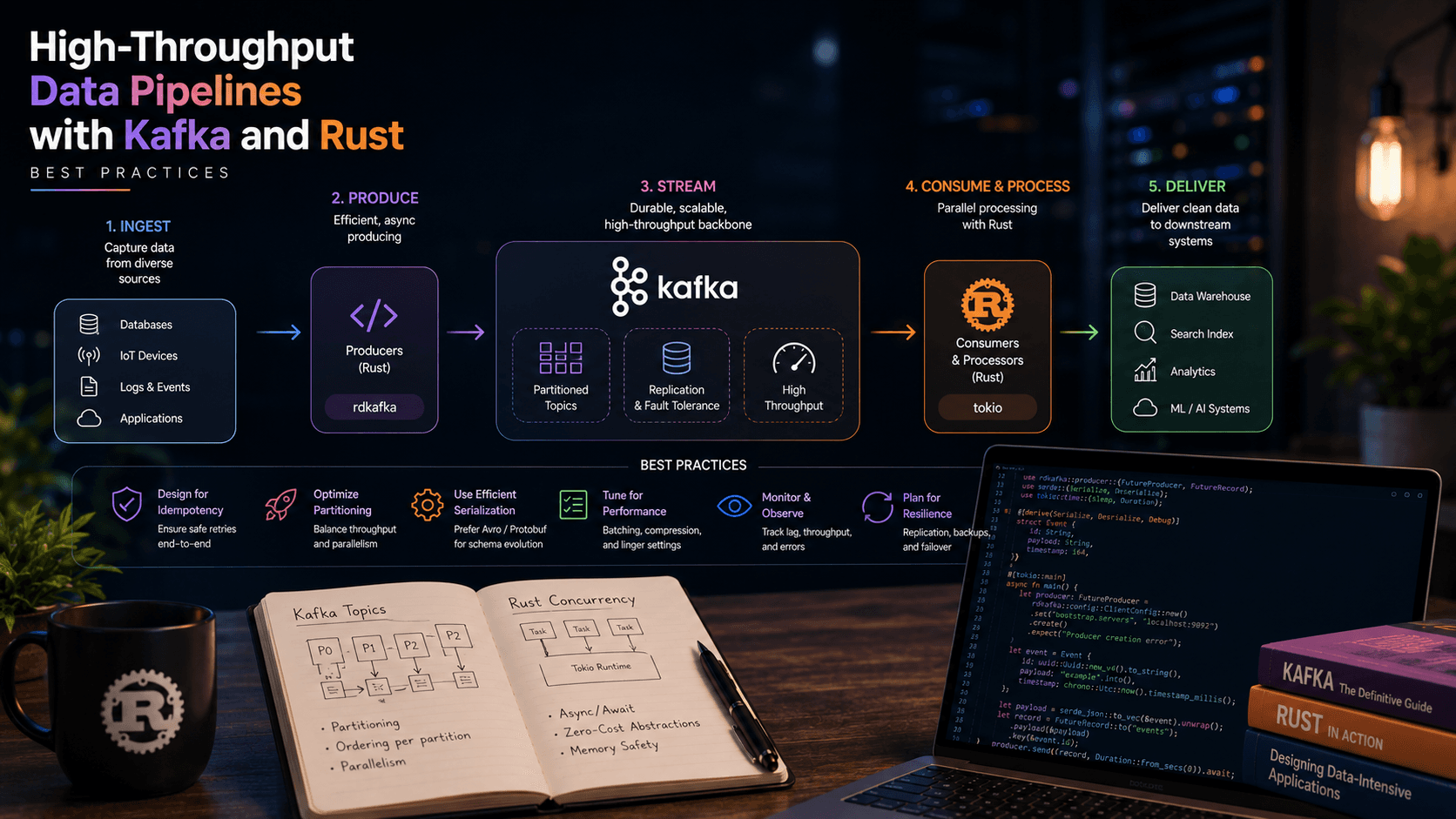
Introduction: The Strategic Context of High-Throughput Data Pipelines with Kafka and Rust
Modern software engineering is an exercise in managing complexity under constraint. As organizations grow, their software systems must scale to handle higher traffic volumes, larger datasets, and growing engineering teams. The challenge lies in building systems that can handle this growth without succumbing to architecture rot, technical debt, and decaying developer velocity. At the heart of this challenge is the balance between short-term feature delivery and long-term codebase maintainability. A rushed architecture might succeed in launching a prototype, but it quickly becomes a bottleneck as the team scales. Sustainable software development requires a commitment to modular design, automated testing, clear API boundaries, and a culture of continuous refactoring.
Core Architectural Principles
The transition from monolithic to microservices architecture is a common milestone for growing teams. While monoliths are easy to deploy initially, they eventually create deployment friction and scaling bottlenecks. Decoupling the codebase into independent, loosely coupled services allows teams to scale development, deployment, and infrastructure in isolation. However, microservices introduce their own set of challenges, particularly around network overhead and data consistency. Adopting an event-driven architecture helps address these issues. By using event streams (such as Kafka) instead of synchronous HTTP calls, services can communicate asynchronously. This reduces direct coupling, improves system resilience, and ensures that failures in one service do not crash the entire application.
Deep Dive Implementation Details
At the implementation layer, database design is the most critical factor in system performance. As tables grow to millions of rows, simple queries can cause locks and high CPU utilization. Developers must design clean schemas, normalize data where appropriate, and apply database indexes strategically. For high-volume write workloads, implementing database partitioning or sharding distributes the load across multiple physical nodes. API design is another critical focus area. Choosing between REST, GraphQL, and gRPC depends on the client-server relationship. While REST is standard and easily cached, gRPC offers high-throughput, low-latency binary serialization that is ideal for internal microservices communication. Using protobuf schemas ensures strict type contracts between services, eliminating runtime integration bugs.
Critical Scaling Bottlenecks
Performance bottlenecks often surface in the form of resource contention and network latency. To combat this, developers should implement caching strategies at multiple layers. This includes using in-memory databases like Redis for fast lookups, utilizing CDNs to distribute static assets globally, and optimizing backend SQL queries to avoid unnecessary joins and round-trips. Concurrency is another common source of performance degradation and bugs. Writing thread-safe code requires a deep understanding of memory sharing, locks, and synchronization primitives. In languages like Go or Rust, leveraging built-in concurrency patterns (such as goroutines and channels, or async/await futures) allows developers to build high-concurrency systems that utilize CPU resources efficiently without race conditions.
Security, Trust & Compliance
Security must be integrated into the software development lifecycle (SDLC) rather than treated as an afterthought. Adopting a zero-trust architecture means that every request, whether internal or external, must be authenticated and authorized. Enforcing strict Role-Based Access Control (RBAC) and validating inputs at the API gateway layer protects the system from common exploits. Automated security scanning in the CI/CD pipeline is critical for catching vulnerabilities early. This includes running Static Application Security Testing (SAST) tools, scanning dependencies for known vulnerabilities, and keeping secrets out of code repositories using tools like HashiCorp Vault. These automated checks act as a security gate, preventing insecure code from reaching production.
Performance Benchmarking & Telemetry
To manage system performance, teams must establish comprehensive observability. This goes beyond basic health checks to include the 'three pillars' of observability: metrics, logs, and distributed tracing. Using tools like Prometheus and Grafana, teams can monitor system health, set up alerts, and diagnose bottlenecks before they impact users. Distributed tracing is particularly valuable in microservices environments. By injecting a correlation ID into the header of every request, developers can trace a transaction's journey across multiple services and databases. This makes it easy to isolate the exact service or database query causing latency, reducing mean time to resolution (MTTR).
Summary & Operational Takeaways
In summary, building enterprise-grade software requires a culture of engineering excellence and operational discipline. By prioritizing modular architecture, automated testing, zero-trust security, and deep observability, software teams can deliver scalable, highly available systems that support business growth without sacrificing developer velocity.
Written by
Dr. Elena Vance
VP of AI Research
Dr. Elena Vance writes about engineering, design, and AI at Magnence — sharing lessons learned from shipping production systems for clients across 13+ industries.