Connecting Legacy SAP to Modern CRMs via Middleware: Best Practices
An in-depth enterprise guide exploring connecting legacy sap to modern crms via middleware. We examine core architectural decisions, data integration pipelines, scaling bottlenecks, and production-grade implementation strategies.
Marcus Wright
Director of Engineering
Introduction: The Strategic Context of Connecting Legacy SAP to Modern CRMs via Middleware
Operational efficiency is the cornerstone of scaling enterprise operations. In many organizations, employees spend thousands of hours on repetitive, manual tasks like data entry, file routing, and invoice reconciliation. Intelligent automation offers a way to streamline these workflows, reducing manual errors, accelerating execution speeds, and freeing up human capital for high-value strategic initiatives. However, enterprise automation is not just about writing simple macros or isolated scripts. It requires designing a secure, observable orchestration layer that integrates with legacy systems, handles API failures gracefully, and scales to process millions of transactions. Sustainable automation requires a commit to standard software engineering practices like error handling, audit logs, and modular design.
Core Architectural Principles
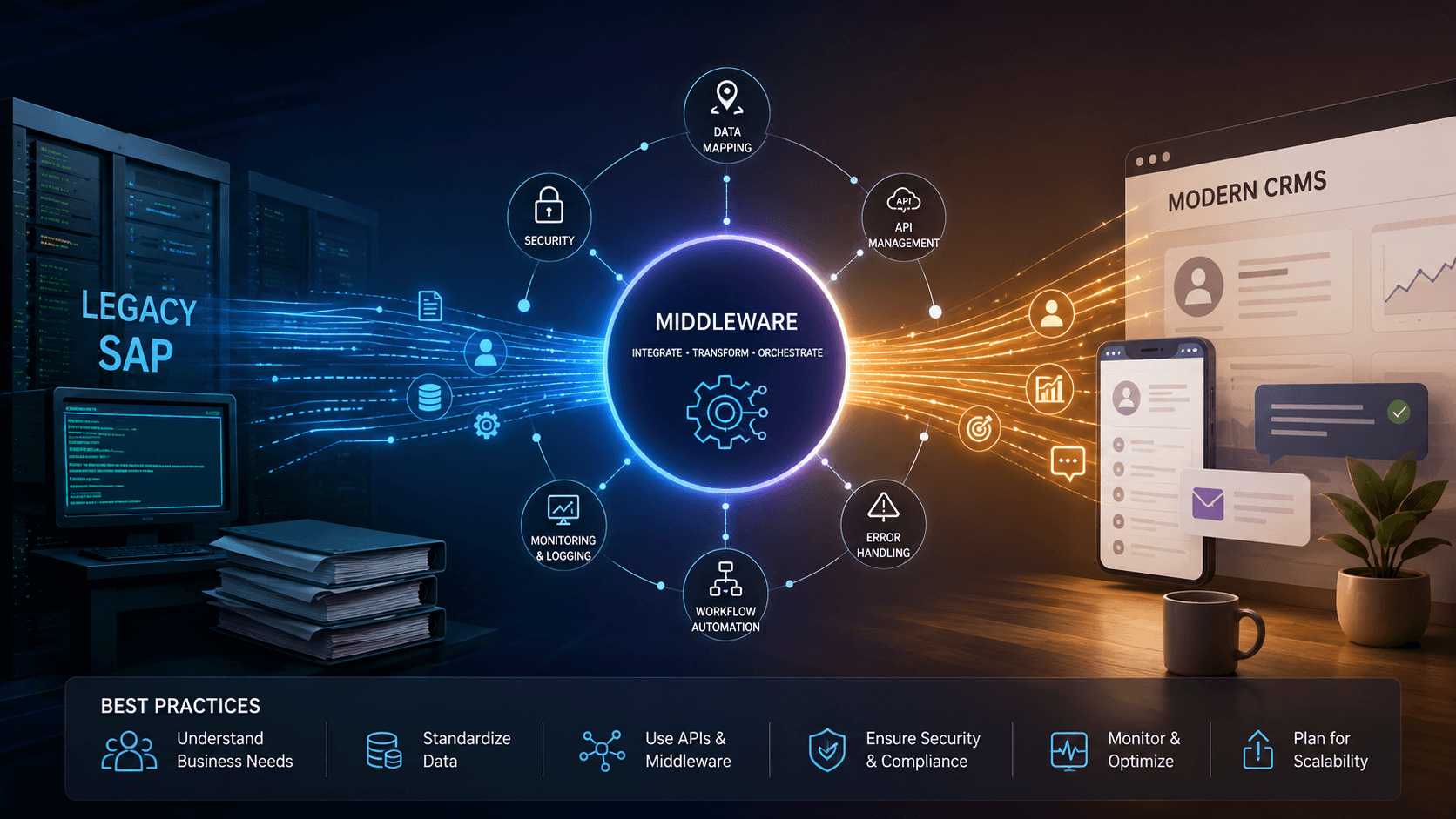
At the core of an automation ecosystem is workflow orchestration. Tools like Apache Airflow or n8n allow teams to model complex processes as Directed Acyclic Graphs (DAGs). This visual representation makes it easy to track task dependencies, schedule executions, and monitor success rates. Orchestrating workflows centrally prevents silent failures and simplifies compliance auditing. Integrating modern cloud services with legacy systems (such as SAP or legacy database servers) often requires middleware. Building custom microservices or API adapters abstracts the complexity of legacy communication protocols, presenting automation scripts with clean, standardized JSON APIs. This decoupling ensures that updates to legacy systems do not break downstream automations.
Deep Dive Implementation Details
At the data extraction layer, Intelligent Document Processing (IDP) is a game changer. Traditional OCR technology often fails when processing unstructured layouts like invoices or receipts. IDP combines OCR with machine learning and LLMs to extract key-value pairs (such as totals, tax IDs, and line items) with high accuracy, automatically routing the structured data into ERP systems. When integrating multiple systems, webhooks are preferred over periodic polling. Webhooks deliver event data instantly, reducing network overhead and latency. However, webhook receivers must be built to be idempotent. This means that if a webhook is delivered multiple times due to a retry policy, the system only processes it once, preventing duplicate transactions and data duplication.
Critical Scaling Bottlenecks
The primary bottleneck in automation workflows is API rate limits and network latency. When a workflow needs to update thousands of records in an external CRM (like Salesforce), sending sequential HTTP requests will hit rate limits and stall execution. Implementing bulk APIs, request batching, and local queues (like BullMQ) allows the system to process tasks in parallel within safe rate limits. Another scaling challenge is handling system downtime. If an external billing system goes offline during a transaction, the automation workflow must not lose the event data. Implementing message brokers (such as RabbitMQ) ensures that transactions are queued safely. Once the target system is back online, the queue processor resumes execution, ensuring zero data loss.
Security, Trust & Compliance
Automation agents often require high-level credentials to read and write across multiple corporate databases. Managing these credentials securely is paramount. Hardcoding passwords or API keys in scripts is a severe security risk. Organizations should use secrets management vaults (like AWS Secrets Manager) and enforce temporary, scoped access tokens for script execution. Audit trails and compliance logging are critical for security. Every action taken by an automation bot must be logged with timestamp, user ID (or bot ID), action details, and target records. This creates a tamper-proof audit trail that compliance teams can review during security audits, ensuring that bot behavior remains transparent and aligned with company policies.
Performance Benchmarking & Telemetry
To monitor the health of automation pipelines, teams should track key operational metrics. This includes measuring average execution times, task failure rates, and system uptime. Using dashboards like Grafana, operational teams can monitor workflow execution in real-time, receiving immediate alerts (via Slack or PagerDuty) if a business-critical pipeline fails. Automated data validation is also essential for maintaining data quality. Before a script writes data to a production database, it should validate it against a predefined schema (using libraries like Zod or Pydantic). If the data is malformed (e.g. text in a currency field), the transaction is routed to a manual review queue, preventing corrupt data from propagating through corporate systems.
Summary & Operational Takeaways
In conclusion, intelligent automation is a powerful catalyst for enterprise scale. By applying software engineering standards—including centralized orchestration, idempotency, secure secrets management, and automated validation—organizations can build resilient automation pipelines that drive efficiency while maintaining security and data integrity.
Written by
Marcus Wright
Director of Engineering
Marcus Wright writes about engineering, design, and AI at Magnence — sharing lessons learned from shipping production systems for clients across 13+ industries.